Upheaval Dome
What is Upheaval Dome?
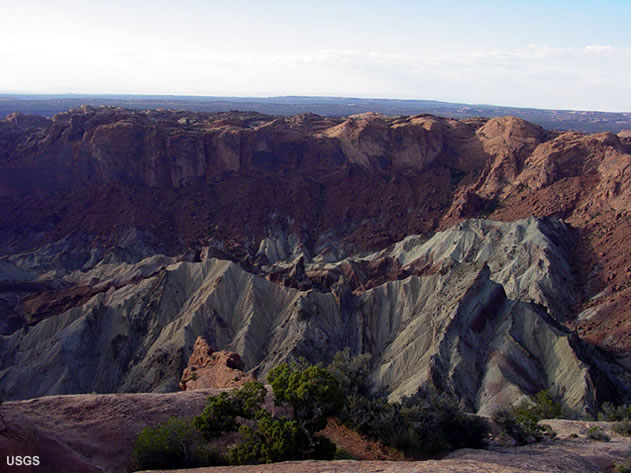
Upheaval Dome is a crater-shaped topographic feature in Canyonlands
National Park. It is about eight thousand feet across and over one
thousand feet deep. Structurally the feature is a deeply eroded dome -
an area where rock units are up-arched a few hundred feet - surrounded
by rocks that are nearly horizontal and undeformed.
Two significantly different processes have received serious attention from geologists and planetary scientists for explaining the origin of Upheaval Dome. One of these proposes that Upheaval Dome is the stump of a deeply eroded salt dome. The other suggests that the feature's shape is consistent with a complex impact structure.
The Salt Dome Theory
Much of southeastern Utah and Canyonlands National Park is underlain by the Paradox Formation, a rock unit composed of thick layers of rock salt interbedded with clastic rocks. The aggregate thickness of salt is over 1000 feet. Because salt has a lower density than other rocks it becomes buoyant when buried. It can also flow under pressure in a way similar to glacial ice.
Some investigators believed that a salt dome developed above the Paradox Formation and that it grew upwards, eventually detaching from the main Paradox salt and moved upwards through the overlying rock like a droplet of oil rising through water. Over millions of years the salt dome and surrounding rock were completely eroded. The feature that we see as Upheavel Dome today was thought to be the pinched off path left behind the rising salt dome located about 1500 feet above the underlying Paradox salt. The upturned orientation of these rock layers was formed when the salt dome pierced through them. No traces of salt are found today because it is such a soluble material.
This idea has been rejected by most Upheaval Dome investigators. Seismic surveys of the area show that the top of the Paradox salt is horizontal immediately below the Upheaval Dome structure. If a salt dome would have grown from the Paradox at that location the surface of the rock unit would be depressed from the loss of salt and show structures that would reveal the detatched salt dome.
The Impact Crater Theory
The impact of an asteroid can also produce a circular structure that is rimmed by upturned strata. The most strongly supported idea for the origin of Upheavel Dome is an impact crater that has been severely eroded. The circular shape, concentric ridges and upturned strata are similar to many eroded impact structures found in other areas.
Investigators testing this hypothesis have searched for meteorite debris but have not found any - most likely because the impact is thought to have occurred about 60 million years ago and any debris from the impacting object have been transformed by weathering and eroded away. However, shattercone structures and shocked quartz grains have been found near the center of the structure. In addition the seismic surveys detected subsurface faulting and fracturing that decreases in intensity with depth and is consistent with the deformation observed beneath other impact structures of clearly proven origin.
The impact crater theory for Upheaval Dome is the most widely accepted explanation of its origin.
|
|
 |
Google Satellite Image / Map of Upheaval Dome, located in Canyonlands National Park, Utah. View Larger Map |
|
Upheaval Dome - photo taken from the rim. USGS Image. |
|
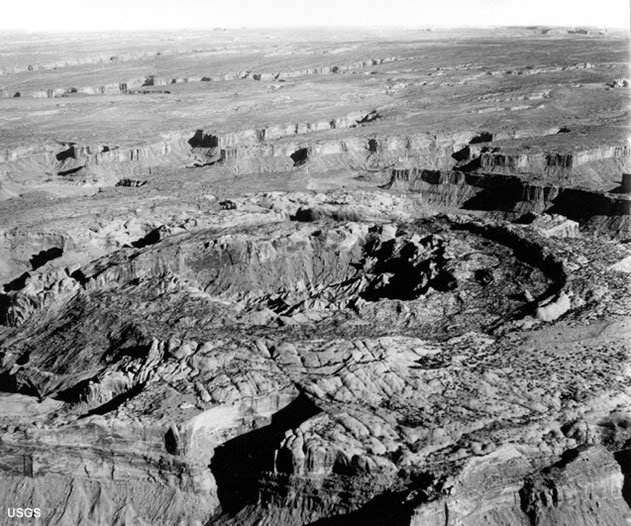
Oblique black and white aerial photo of Upheaval Dome taken from aircraft. USGS image, H.R. Joesting. |
|
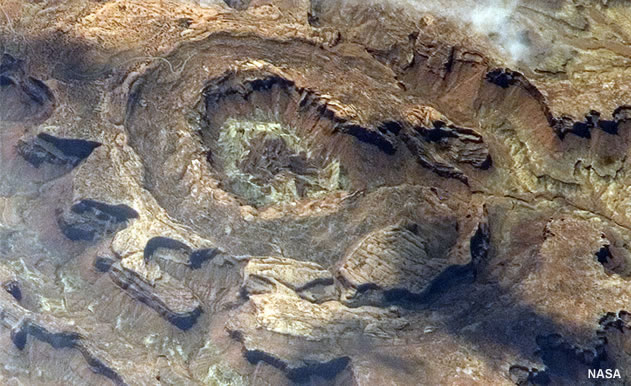
Oblique view of Upheaval Dome taken by a NASA astronaut aboard the International Space Station. Exposed in the center of the structure is the Wingate Sandstone, surrounded by the Kayenta Formation, and Navajo Sandstone. |
|

